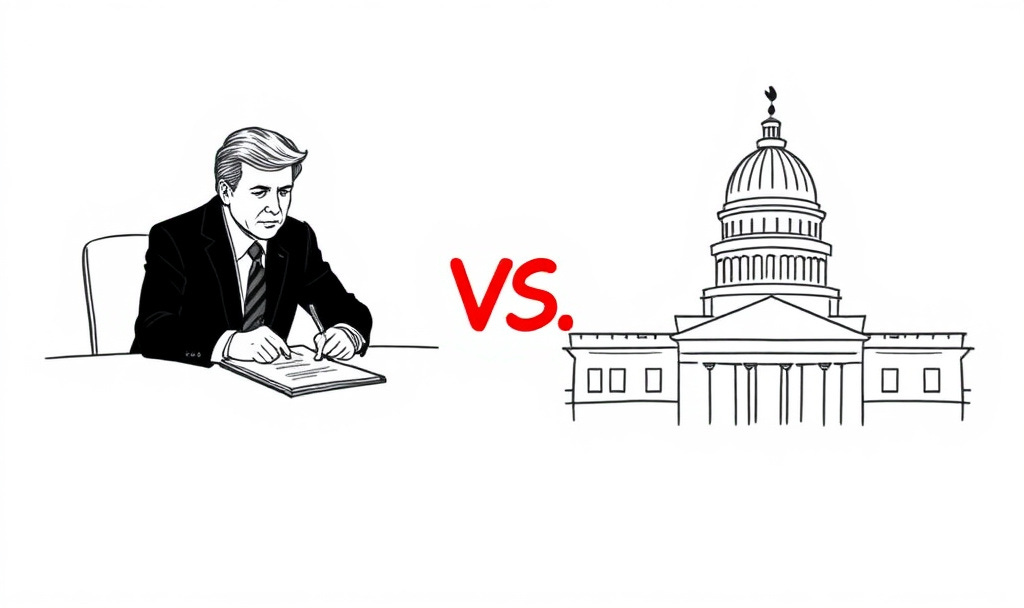
“The President’s power to see that the laws are faithfully executed refutes the idea that he is to be a lawmaker.”
— Justice Hugo Black, Youngstown Sheet & Tube Co. v. Sawyer, June 2, 1952.
Despite Justice Black’s warning, our governmental system has evolved to the point where major national policy can change dramatically every four or eight years with the stroke of a pen.
America was founded in opposition to concentrated executive power. The Revolution itself was, in many ways, a rejection of rule by decree and governance imposed without meaningful representation. Having experienced the authority of a king, the Founders were deeply wary of placing too much power in the hands of any single executive.
That concern shaped the nation’s earliest governing structure. The Articles of Confederation created no independent executive branch at all. But while the Articles proved too weak to govern an emerging nation effectively, the Constitution that followed sought balance rather than monarchy. It created a stronger presidency, but one constrained by Congress, the courts, and the separation of powers.
The Founders intentionally vested lawmaking authority in Congress because they believed major national policy should emerge through deliberation, compromise, and democratic consent — not unilateral executive action. Ironically, nearly 250 years later, the nation again finds itself debating the same fundamental question that shaped its founding: how to preserve effective government without concentrating too much power in a single executive.
The balance between Executive and Congressional power has steadily shifted.
Modern presidential transitions increasingly begin not with legislative agendas, but with immediate efforts to reverse the Executive Orders of prior administrations. National policy now oscillates between administrations in ways that create instability for businesses, institutions, agencies, allies, and the public itself.
This is not simply a partisan concern. Every administration inherits powers expanded by previous administrations and then pushes those powers further. What one president creates, the next president uses. The cycle repeats, executive authority grows, and Congress weakens further.
Ironically, America’s constitutional problem today may not be that presidents have become too strong, but that Congress has become too weak.
For decades, Congress has increasingly delegated broad policymaking authority to federal agencies while avoiding politically difficult decisions itself. Rather than writing narrow and precise laws, Congress often passes sweeping legislation that leaves enormous discretion to executive agencies and future administrations. When legislative gridlock follows, presidents step into the vacuum through Executive Orders and emergency declarations.
The constitutional system the Founders designed depended upon ambition countering ambition. Congress was expected to defend its own institutional authority. Too often, it has surrendered that authority voluntarily.
This growing imbalance was anticipated long ago. In his Farewell Address, George Washington warned that excessive factionalism and concentrated political power could eventually threaten republican government itself:
“Sooner or later the chief of some prevailing faction, more able or more fortunate than his competitors, turns this disposition to the purposes of his own elevation on the ruins of public liberty.”
Washington’s warning feels remarkably modern. In an era of polarization and legislative paralysis, Americans increasingly expect presidents to accomplish through unilateral action what Congress cannot or will not do legislatively. But temporary political victories were never intended to become substitutes for the constitutional process itself.
None of this means America should have a weak presidency. The nation still requires an executive branch capable of acting decisively during wars, terrorist attacks, economic crises, cyberattacks, natural disasters, and genuine national emergencies. The Constitution was designed to create an energetic executive, not a powerless one.
But there is an important distinction between temporary emergency action and lasting policymaking by executive decree.
That distinction should form the basis for serious Executive Order reform.
A modern reform framework should recognize two separate categories of Executive Orders.
The first category would involve genuine emergency Executive Orders. These would allow presidents to act immediately during urgent national crises when delay could cause imminent harm, and Congress cannot reasonably act first. For example, emergencies of military attack, cyberattack, natural disaster, pandemic outbreak, financial system collapse, hostage crisis, and sudden infrastructure sabotage would all require immediate action.
However, even these emergency actions should remain temporary. Such orders should automatically expire after a defined period unless affirmatively approved by Congress through expedited review procedures.
The second category would involve standard administrative Executive Orders addressing non-emergency policy matters and executive branch management. Presidents must retain the ability to direct agencies and administer existing law, but major long-term national policy changes should not become permanent without congressional participation and accountability. For example, orders relating to immigration policy, environmental rules, trade priorities, energy development, workplace regulations, public health policy, and countless other areas were once expected, if not required, to move primarily through Congress. Presidents have now begun addressing these matters with Executive Orders.
The principle is simple: emergencies may justify temporary executive speed, but they should not justify what amounts to lasting executive lawmaking.
Most importantly, congressional silence should no longer equal consent.
Under the current system, unilateral executive actions often remain in effect indefinitely unless Congress gathers the political strength to stop them. Reform should reverse that burden. Presidents may act temporarily when necessary, but lasting national policy should require affirmative democratic approval through the legislative branch.
Congress should also establish expedited bipartisan review procedures and fast-track judicial review for major Executive Orders and emergency declarations. Presidents will inevitably be tempted to define more and more issues as emergencies, particularly in an era where election victories, however slight, are increasingly interpreted as broad governing mandates. Stronger institutional safeguards are therefore essential to preserve constitutional balance.
Importantly, Executive Orders themselves are not mentioned in the Constitution. Their modern scope evolved gradually through custom, congressional delegation, and judicial interpretation. Congress, therefore, possesses substantial authority to regulate how Executive Orders are classified, reviewed, extended, and limited.
Such reforms would likely face resistance from presidents of both parties. Executive branches rarely surrender power voluntarily. Yet preserving constitutional balance matters more than the temporary political advantage of any administration. Meaningful reform would likely require bipartisan congressional resolve, as executive branches rarely surrender power voluntarily.
There is also a practical reason for reform beyond constitutional theory alone.
Businesses, industries, universities, state governments, military planners, and America’s international allies all depend upon a degree of long-term policy stability. Major investments in manufacturing, energy, infrastructure, trade, technology, and national security often require planning horizons measured in decades, not election cycles.
But when major national policies repeatedly reverse through unilateral executive action, uncertainty grows. Businesses delay investment. Agencies constantly rewrite regulations. International allies question whether American commitments will survive the next election. Long-term strategic planning becomes more difficult because policy increasingly depends not upon durable legislation, but upon temporary executive directives.
Short-term unilateral action may appear efficient politically, but constant policy reversals ultimately create instability and inefficiency for the nation itself.
The Founders rejected both monarchy and governmental paralysis. They designed a constitutional system intended to balance energy with restraint, speed with accountability, and leadership with representation. Over time, that balance has eroded as Congress weakened and executive authority expanded.
Executive Order reform is not about weakening the presidency. It is about restoring Congress to its proper constitutional role and ensuring that major national policy once again reflects a durable democratic consensus rather than a temporary unilateral decree.
After nearly 250 years, America may once again be confronting the same challenge that shaped its founding: preserving an effective government without allowing concentrated power to overwhelm representative self-government. The system does not function properly when any one branch becomes dominant at the expense of the others.