
One Path Left to Impeachment

In today’s hyper-partisan Washington, calls for impeachment have become almost routine—more a reflection of political frustration than a viable governing strategy. Pundits debate the merits, party leaders posture, and voters are left to wonder whether any of it can actually lead to action.
Under current conditions in the House of Representatives, the answer is almost always no. However, if the House majority changes next year, the dynamics will be entirely different. The more immediate question is whether the current leadership structure is sustainable until next year.
But there is one procedural path—largely overlooked and seldom discussed—that could force the issue onto the House floor. It is rarely used, difficult to execute, and politically risky. Yet it may be the only plausible near-term avenue available to compel a vote on the impeachment of Donald Trump.
That path is the discharge petition.
To understand why it matters, it helps to first understand why the traditional routes are effectively closed. Impeachment resolutions, like most legislation, are controlled by House leadership. If leadership chooses not to bring a measure to the floor, it typically goes nowhere, regardless of public pressure or media attention.
Some have pointed to the Twenty-fifth Amendment to the United States Constitution as an alternative mechanism for addressing presidential fitness. But that process requires initiation by the vice president, in coordination with the Cabinet or a congressionally authorized body. Without that internal executive branch trigger, the 25th Amendment is not a viable path forward.
That leaves Congress—and more specifically, the House.
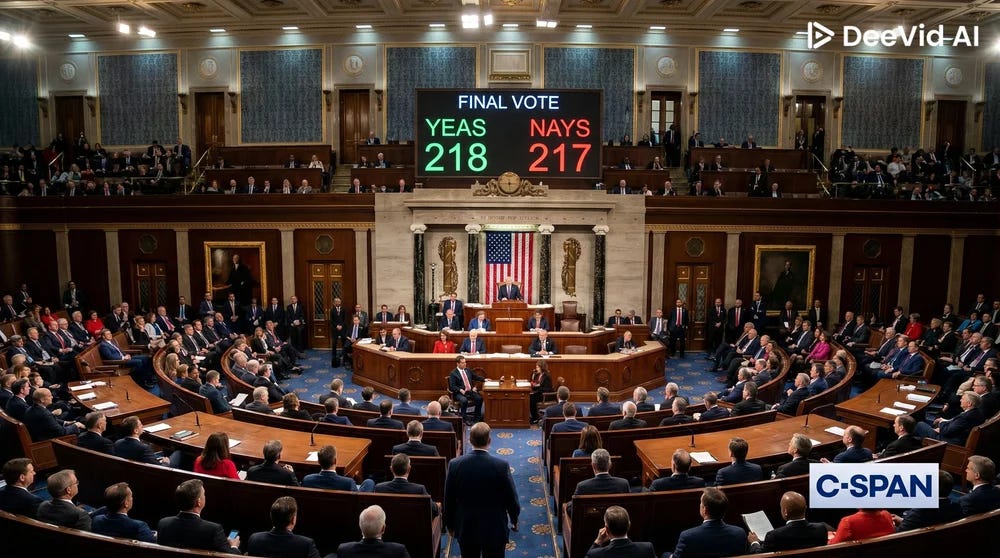
A discharge petition is one of the few tools rank-and-file members have to bypass leadership control. If 218 members—a majority of the full House—sign a petition, a bill or resolution that has been stalled in committee can be brought to the floor for a vote. It is a blunt instrument, but a powerful one.
The math is straightforward. There are 213 Democrats in the House. If all were to support a discharge petition related to impeachment, only five Republicans would be needed to reach the 218 threshold.
Five votes.
In a chamber defined by sharp partisan divisions, that number seems both small and impossibly large at the same time.
Skeptics will rightly point out that impeachment is not a typical policy vote. It is a defining political act, one that carries consequences not just for a member’s current position, but for their standing within their party and their future beyond Congress. Party loyalty, donor relationships, and long-term political identity all weigh heavily on such decisions.
And yet, there is a narrow lane where those pressures may begin to shift.
Dozens of Republican House members are not seeking reelection. Freed from the immediate demands of another campaign, these members are, at least in theory, less constrained by electoral politics. That does not make them immune to party influence, but it does change the calculation. Legacy, institutional responsibility, and personal judgment can carry more weight when the next primary is no longer a concern.
For a discharge petition to succeed, however, it is not enough to rely on personal independence alone. The decisive factor is pressure—specifically, pressure that reaches beyond national headlines and into the lived experience of constituents.
Public opinion in the United States is deeply polarized, and national-level outrage often reinforces existing divisions rather than bridging them. But when issues begin to affect voters in tangible, local ways, the political equation can change.
Rising costs tied to energy and agriculture, for example, do not fall neatly along partisan lines. Farmers facing higher fertilizer prices, families struggling with fuel costs, and small business owners navigating economic uncertainty are not abstractions. They are constituents. When economic strain becomes personal, it can create a form of cross-pressure that members of Congress cannot easily dismiss.
Similarly, concerns about stability, governance, and America’s standing with allies resonate beyond partisan talking points for some voters—particularly in suburban and business-oriented districts. These are not always dominant issues, but they can become influential under the right circumstances.
History suggests that discharge petitions only succeed when public pressure becomes both intense and, crucially, bipartisan. Impeachment does not naturally fit that model. But if the effects of national leadership begin to cut across party lines in meaningful ways, the political cost-benefit analysis for a small number of members could shift.
Even then, success is far from guaranteed.
But success is not the only meaningful outcome.
A serious discharge petition effort would force members to take a public position—either by signing on or declining to do so. It would create a clear record of where each representative stands, not in rhetoric, but in action. It could expose fractures within party unity, however small, and signal to voters that the issue is not confined to partisan messaging alone.
At a minimum, it would move the conversation from speculation to accountability.
In a legislative body designed with multiple layers of gatekeeping, it is easy for difficult issues to be quietly set aside. Leadership decides what advances. Committees decide what is considered. And members can avoid taking positions on controversial matters simply because those matters never reach the floor.
A discharge petition disrupts that pattern. It does not guarantee an outcome, but it forces a decision.
That, in itself, is significant.
The reality is that there are no easy paths to impeachment in the current political environment. There are no shortcuts around partisanship, no mechanisms that bypass the need for political courage. The barriers are real, and they are high.
But systems built to resist action also contain, by design, narrow channels through which action can still occur.
The discharge petition is one of those channels.
It is a long shot. It requires near-unity on one side of the aisle and a willingness from a small number on the other to break with precedent. It demands sustained public engagement and a shift in how political pressure is applied.
But in a moment when many assume that no path exists at all, it stands as a reminder that the architecture of Congress still allows, however rarely, for the will of its members to override the inertia of its leadership.
Long shots are still shots.
And sometimes, they are the only ones left.
J.P.
Do you have an email address? Can I get it from you so I can talk to you?
Great post. It will be up tomorrow at AB also.
Bill